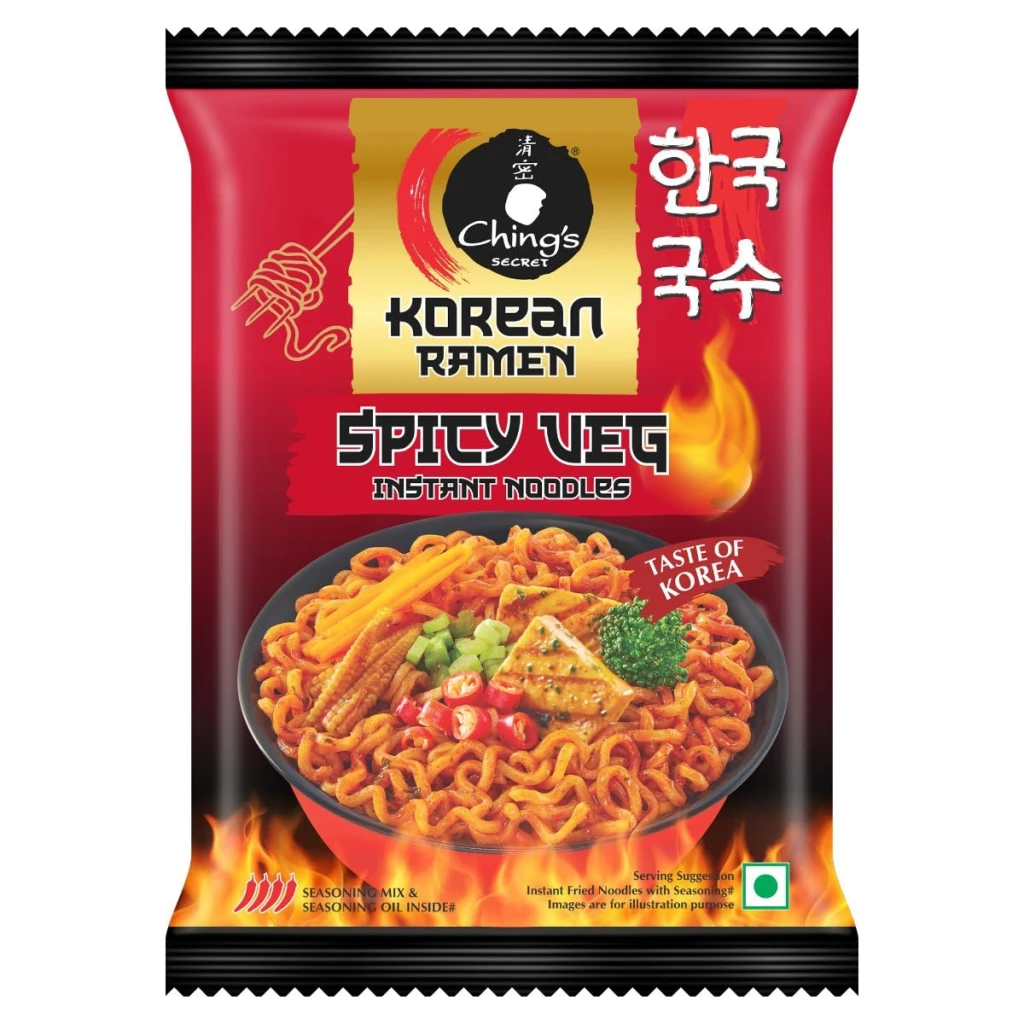
Pack image shown to identify the product. Decode Label is independent of Ching's Secret and is not sponsored or endorsed by it. Trademarks
Korean Ramen Spicy Veg Instant Noodles
Decode Label Safety Score
How we got 3.0 ShowHide
Methodology v3.1 (updated 8 Oct 2026) — what changed
This instant noodle product is primarily a source of refined carbohydrates and fats, with notable levels of sodium and added sugar. The presence of TBHQ as an antioxidant and Disodium 5'-ribonucleotides as a flavour enhancer are points of concern for specific subgroups. While the product provides quick energy, its nutritional profile suggests it is best consumed in moderation, especially for individuals monitoring their intake of sodium, saturated fat, and certain additives. The use of plain caramel (INS 150a) is also noted, which is classified by IARC as Group 3, not classifiable as to its carcinogenicity to humans.
At a glance
From the declared label — not a lab testFindings to weigh
What’s favorable
- Dehydrated Garlic
- Chilli
- Dehydrated Onion
- Mixed Spices
- Tomato Powder
- +2 more →
High in sodium and saturated fat; contains TBHQ and flavour enhancers
This instant noodle product contains refined palm oil, contributing to saturated fat intake, and has high sodium levels. It includes TBHQ, an antioxidant, and disodium 5'-ribonucleotides, a flavour enhancer that may be relevant for individuals managing gout. The product also uses plain caramel (INS 150a) for colour, which is classified by IARC as Group 3.
Consider this product carefully if you are
- Avoiding certain additives or colours — Refined Palm Oil and Flavour Enhancer are declared.
Declared allergens: Soy, Gluten and Sulphites
Relevant if you have any of these allergies or intolerances.
Based on the declared ingredient list. This is a risk only to people with the allergy, not a general-population safety issue, so it does not lower the safety score.
Concern breakdown
Score out of 10 · higher = fewer concernsHow this product performs on each concern we check for food. This is a breakdown of the same evidence behind the score above — not a separate verdict.
Saturated fat 4.5 g · trans fat 0 g per serving
Toddlers & young children (1–5)
LimitHigh sodium and added sugar content may not be suitable for frequent consumption by young children, as their dietary needs differ from adults.
Why the score is capped
Very high sodium per serving
Rule F-CAP-02
Flavours not disclosed — the label does not say which substance this is
Rule F-CAP-13
What's good
Contains natural spices and herbs for flavour
Iodised salt provides essential iodine
Watch out for
High sodium content, which can contribute to high blood pressure
High saturated fat content from refined palm oil
Contains added sugar, which should be consumed in moderation
Presence of TBHQ as an antioxidant
Disodium 5'-ribonucleotides may be a concern for individuals with gout
Contains gluten, unsuitable for those with celiac disease or gluten sensitivity
Texturizer — iNS 451(i) (triphosphates) are used for texture and water retention, generally considered safe in regulated amounts.
Ingredient Concerns safety database
Sources cited below may be Indian (FSSAI) or international (EU, US, WHO, IARC) — an international classification or law is evidence, not an Indian regulatory finding.
Palm Oil
Palm oil is about half saturated fat, which raises LDL cholesterol when eaten regularly in quantity, and the WHO advises keeping saturated fat under 10 percent of energy. Refined palm oil also carries the highest levels of process contaminants among edible oils: glycidyl esters, which the European Food Safety Authority considers genotoxic and carcinogenic with no safe level, and 3-MCPD esters, for which it set a tolerable daily intake of 2 micrograms per kilogram of body weight in 2018. IARC lists glycidol as probably carcinogenic (Group 2A) and 3-MCPD as possibly carcinogenic (Group 2B). The contaminants form during the high-temperature deodorising step of refining, so unrefined palm oil carries less of them. EU maximum levels now apply to these contaminants in oils and in infant formula.
Regulatory & scientific authority Source: EFSA CONTAM Panel opinions on glycidyl esters and 3-MCPD esters in food (2016) and 3-MCPD update (2018); IARC Monographs Volumes 77 and 101; WHO guideline on saturated fat and trans fat intake (2023)
Palm Oil: regulation, sources and other products →Disodium Ribonucleotides (E635)
E635 is a mixture of disodium inosinate (E631) and disodium guanylate (E627). Both are purine nucleotides, which the body breaks down to uric acid. People with gout or hyperuricaemia, or who have been advised to limit purines, may wish to limit foods containing it. The amounts used in foods are small, so the concern applies to people already managing uric acid rather than to the general population.
Regulatory & scientific authority Source: EFSA; WHO; Arthritis Foundation
Disodium Ribonucleotides: regulation, sources and other products →Hydrolysed Vegetable Protein
Hydrolysed vegetable protein is a savoury flavour base made by breaking vegetable protein into amino acids, which gives a concentrated glutamate taste. When it is made with acid, chloropropanols such as 3-MCPD can form as a by-product, and the EU food safety authority has set a tolerable daily intake for 3-MCPD. The label does not say how it was made, so this is information, not a finding about this product.
Regulatory & scientific authority Source: EFSA Panel on Contaminants, Risks for human health related to the presence of 3- and 2-monochloropropanediol (MCPD) and glycidyl fatty acid esters in food, EFSA Journal 2016;14(5):4426
Hydrolysed Vegetable Protein: regulation, sources and other products →Added Sugars
Sugars added to food, and the sugars in honey, syrups and fruit juice concentrates, are "free sugars". The WHO guideline recommends that they stay below 10% of total energy intake and suggests below 5% for additional benefit. Where the sugar sits in the ingredient list and how many grams the panel declares is what matters; this is information, because the nutrition score already prices the grams.
Regulatory & scientific authority Source: WHO, Guideline: Sugars intake for adults and children (2015)
Added Sugars: regulation, sources and other products →Flavouring Substances
Indian rules classify added flavours as natural, nature-identical (chemically synthesised copies of natural compounds) or artificial, and require the class to be declared. The label names the class, not the compounds, so a reader cannot see which substances make up the blend, or whether it carries something they avoid. This is information about transparency, not a finding of harm.
Regulatory & scientific authority Source: FSS (Food Products Standards and Food Additives) Regulations 2011, flavours; FSS (Labelling and Display) Regulations 2020
Flavouring Substances: regulation, sources and other products →Wheat Flour
Wheat and wheat-derived ingredients contain gluten, which triggers an autoimmune response in people with celiac disease, causing intestinal damage. People with non-celiac gluten sensitivity (NCGS) or wheat allergy must also avoid this ingredient. Labelled as a major allergen by FSSAI.
Regulatory & scientific authority Source: FSSAI Food Labelling Regulations; Celiac Disease Foundation
Wheat Flour: regulation, sources and other products →Decode Label Analysis
Refined Palm Oil is high in saturated fat and may contain processing contaminants (glycidyl esters, 3-MCPD) depending on refining processes, as per EFSA CONTAM opinion (2016).
Disodium 5'-ribonucleotides (INS 635) is a flavour enhancer and a purine source, which may be relevant for individuals managing gout.
TBHQ (INS 319), used as an antioxidant in refined palm oil and refined sunflower oil, is a synthetic antioxidant with some regulatory restrictions and concerns about potential health effects at high doses.
Plain caramel (INS 150a) is used as a colour. IARC classifies plain caramel as Group 3, not classifiable as to its carcinogenicity to humans.
Hydrolyzed Vegetable Protein Powder and Hydrolyzed Soy Protein are savoury flavour bases; acid-hydrolysed versions can carry process contaminants, though specific processing is not disclosed here.
Nature-Identical Flavouring Substances and Natural Flavours are blends whose individual compounds are not listed, which may be a concern for individuals with specific flavour sensitivities.
Claim check
Front-of-pack marketing claims checked against this product's actual ingredients and nutrition. "Can't verify" means the label does not provide enough information to check the claim — it is not the same as the claim being false.
This describes the product’s packaging or its category, not a testable attribute of the food itself — so it’s classified separately rather than flagged as a doubtful claim.
The claim 'Taste of Korea' is a subjective sensory claim and cannot be objectively verified from the ingredient list or nutrition facts.
The claim refers to components inside the packaging, which cannot be verified from the provided ingredient list or nutrition facts.
This describes the product’s packaging or its category, not a testable attribute of the food itself — so it’s classified separately rather than flagged as a doubtful claim.
This is a disclaimer about the images and not a verifiable claim about the product's composition or nutritional content.
The ingredients list chilli (9%) and various dehydrated vegetables like garlic and onion, supporting the 'Spicy Veg' claim.
Read straight from the back-of-pack photo — quantities, sections and any disguised terms, so the small print can’t hide behind the marketing.
33 entries as printed on the label · 28 distinct ingredients (some are declared more than once).
-
1.
Refined Wheat FlourRefined Wheat Flour (Maida)
-
2.
Refined Palm OilRefined Palm Oil (Antioxidant (INS 319))
-
3.
ThickenersThickeners (INS 1420, INS 508)
-
4.
Wheat GlutenWheat Gluten (Antioxidant (INS 1102))
-
5.
Iodised Salt
-
6.
TexturizerTexturizer (INS 451(i))
-
7.
Acidity RegulatorAcidity Regulator (INS 501(i))
-
8.
Raising AgentRaising Agent (INS 500(ii))
-
9.
Sugar
-
10.
Hydrolyzed Vegetable Protein PowderHydrolyzed Vegetable Protein Powder [Hydrolyzed Soy Protein, Maltodextrin, Iodised Salt]
-
Hydrolyzed Soy Protein within Hydrolyzed Vegetable Protein Powder
-
Maltodextrin within Hydrolyzed Vegetable Protein Powder
-
Iodised Salt within Hydrolyzed Vegetable Protein Powder
-
11.
Dehydrated Garlic
-
12.
Chilli 9%Chilli (9%)
-
13.
Soy Sauce PowderSoy Sauce Powder [Soy Sauce, Maltodextrin, Salt, Colour (INS 150a)]
-
Soy Sauce within Soy Sauce Powder
-
Maltodextrin within Soy Sauce Powder
-
Salt within Soy Sauce Powder
-
Colour within Soy Sauce Powder synthetic colourPlain caramel (INS 150A)Colour (INS 150a)
-
14.
Dehydrated Onion
-
15.
Flavour EnhancerFlavour Enhancer (INS 635)
-
16.
Natural Flavour listed twice
-
17.
Mixed Spices
-
18.
Tomato Powder
-
19.
Anticaking AgentsAnticaking Agents (INS 551, INS 470a)
-
20.
Dehydrated Herb
-
21.
Acidity RegulatorAcidity Regulator (INS 330)
-
22.
Refined Sunflower Oil listed twiceRefined Sunflower Oil (Antioxidant (INS 319))
-
23.
Nature-Identical Flavouring Substances
-
24.
Refined Sunflower Oil listed twiceRefined Sunflower Oil (Antioxidant (INS 319))
-
25.
Natural Flavour listed twice
-
26.
Spice Oleoresin
Listed twice: an ingredient appears more than once in the same part of the list. This may indicate two separate ingredient blends in the formulation, or a duplication in how the label was recorded.
In label order — normally largest quantity first. Select a row for the full write-up and sources.
A blend of refined vegetable oils, judged as a single concern — a high saturated-fat source — rather than one flag per oil. The individual oils are listed below and in "What the label actually shows".
These are major food allergens named on the ingredient list. They are a risk only to people allergic to them — not a general-population safety issue — so they do not lower the safety score. Anyone with the allergy should avoid this product, and check the pack’s own allergen statement.
The label declares each of these as a blend and then lists what is in it. The components appear in the groups above on their own merits, so the blend itself is shown here rather than counted a second time.
✓ Decode Label Assessment: Favorable ⚠ Decode Label Assessment: Concern Decode Label Assessment: Neutral
Who should take caution
About this ingredient
Declared on this label as
No detailed safety data in our database yet for this ingredient.
Learn More
| Energy | 357 kcal |
| Protein | 7.3 g |
| Carbohydrate | 52.2 g |
| Total Sugars | 3 g |
| Added Sugars | 2.6 g |
| Total Fat | 13.2 g |
| Saturated Fat | 4.5 g |
| Trans Fat | 0 g |
| Sodium | 1,166 mg |
Colour shows the per-100g level (green = low, amber = moderate, red = high), calculated from the declared serving — this label prints per-serving figures only.
Compare with other instant noodles products
Assessed using the same Decode Label methodology, sorted by score. Each score reflects the information available for that product at the time of assessment.
Also on this shelf
More Instant Noodles & Pasta products we've analysed, in name order.
-
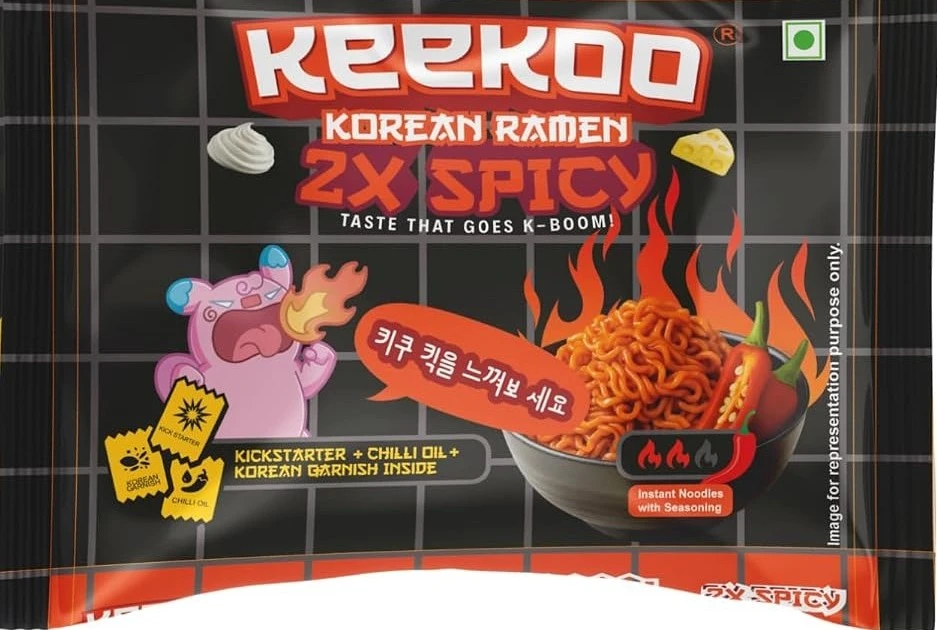 KEEKoo Korean Ramen 2X Spicy
See the analysis
-
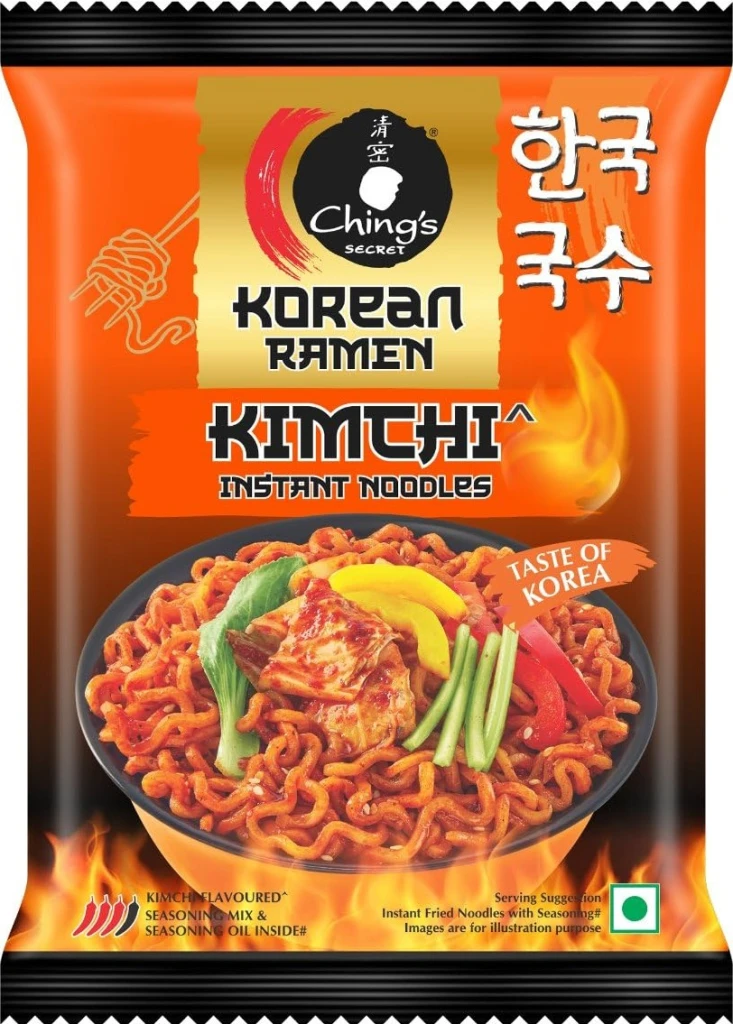 Ching's Secret Korean Ramen Kimchi Instant Noodles
See the analysis
-
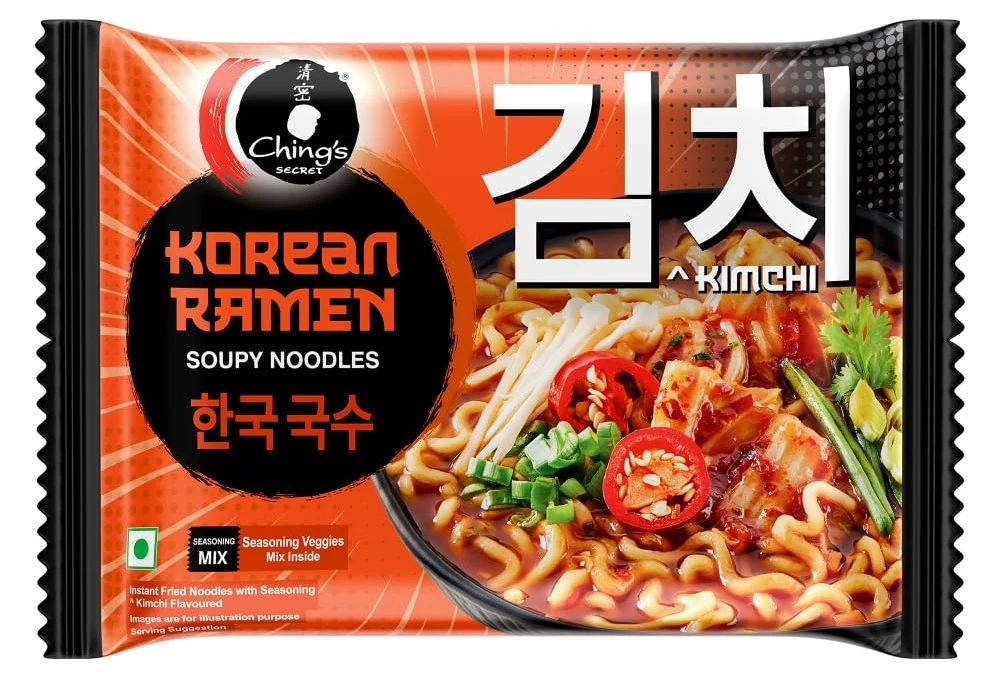 Ching's Secret Korean Ramen Soupy Noodles Kimchi Flavoured
See the analysis
-
 Nestle Maggi 2 min noodles Masala Taste
See the analysis
-
 Maggi MAGGI 2-Minute Instant Noodles, Favourite Masala Taste, Masala Noodles With Goodness Of Iron, Made With Choicest Quality Spices
See the analysis
-
 Maggi MAGGI Korean Spicy Cheesy Cuppa Noodles
See the analysis
What are the ingredients in Korean Ramen Spicy Veg Instant Noodles?
The label of Korean Ramen Spicy Veg Instant Noodles lists 28 ingredients, in label order: Refined wheat flour, Refined Palm Oil, Thickener, Wheat gluten, Texturizer, Raising Agents, Sugar, Hydrolyzed Vegetable Protein Powder, Hydrolyzed Soy Protein, Iodised Salt, Dehydrated Garlic, Chilli, Soy Sauce Powder, Soy Sauce, Maltodextrin, Salt, Colour, Dehydrated Onion, Flavour Enhancer, Mixed Spices, Tomato Powder, Anticaking Agents, Dehydrated herb, Acidity Regulator, Nature-Identical Flavouring Substances, Refined Sunflower Oil, Natural Flavours, Spice Oleoresin. Flagged by the analysis: Flavour Enhancer, Nature-Identical Flavouring Substances, Texturizer, Hydrolyzed Vegetable Protein Powder.
Is Korean Ramen Spicy Veg Instant Noodles safe to eat?
Korean Ramen Spicy Veg Instant Noodles scores 3.0/10 on Decode Label (Concerning). This instant noodle product contains refined palm oil, contributing to saturated fat intake, and has high sodium levels. It includes TBHQ, an antioxidant, and disodium 5'-ribonucleotides, a flavour enhancer that may be relevant for individuals managing gout. The product also uses plain caramel (INS 150a) for colour, which is classified by IARC as Group 3.
Why does Korean Ramen Spicy Veg Instant Noodles score 3.0/10?
What the analysis notes: High sodium content, which can contribute to high blood pressure. High saturated fat content from refined palm oil. Contains added sugar, which should be consumed in moderation.
Who should avoid Korean Ramen Spicy Veg Instant Noodles?
The points the analysis notes are most relevant to: Managing gout (due to purine source); Sensitive to TBHQ; Monitoring sodium intake; Monitoring saturated fat intake; Gluten sensitivity or celiac disease.
Is Korean Ramen Spicy Veg Instant Noodles suitable for babies or young children?
Toddlers & young children (1–5): Limit.
Does Korean Ramen Spicy Veg Instant Noodles contain allergens?
Yes — the ingredient list contains soy (Hydrolyzed Soy Protein, Soy Sauce Powder and Soy Sauce), gluten (Refined wheat flour and Wheat gluten) and sulphites (the pack’s allergen statement). Check the allergen statement on the pack too if you have a diagnosed allergy.
Does Korean Ramen Spicy Veg Instant Noodles contain soy?
Yes — the ingredient list names Hydrolyzed Soy Protein, Soy Sauce Powder and Soy Sauce. People with soy allergy should treat it as containing soy, and check the allergen statement on the pack too.
Does Korean Ramen Spicy Veg Instant Noodles contain gluten?
Yes — the ingredient list names Refined wheat flour and Wheat gluten. People with gluten / wheat sensitivity (coeliac disease) should treat it as containing gluten, and check the allergen statement on the pack too.
Does Korean Ramen Spicy Veg Instant Noodles contain sulphites?
Yes — the ingredient list names the pack’s allergen statement. People with sulphite sensitivity (asthma) should treat it as containing sulphites, and check the allergen statement on the pack too.
How much sugar is in Korean Ramen Spicy Veg Instant Noodles?
3.8 g of total sugar per 100 g. The label declares 3.3 g of that as added sugar per 100 g.
Is Korean Ramen Spicy Veg Instant Noodles high in salt?
Yes — 1,458 mg of sodium per 100 g (about 3.64 g of salt), above the 1.5 g of salt per 100 g that UK front-of-pack labelling marks as high.
Are the claims on the Korean Ramen Spicy Veg Instant Noodles pack accurate?
Decode Label checked 4 claims against the ingredient list and nutrition panel. "Taste of Korea" — can't be verified from the label. "SEASONING MIX & SEASONING OIL INSIDE#" — can't be verified from the label. "Images are for illustration purpose" — can't be verified from the label.
Answers are generated from this product's own Decode Label analysis — the score, the ingredient list and the label claims shown above. Always check the pack itself for allergen and dietary information.
Reader reviews
How the product performed for people who used it — taste, value, everyday experience. Separate from the Decode Label score above, which rates what is on the label.
Sign in to leave a review.
Sign in →No reviews yet — be the first to share your experience.
Help us keep this accurate
Two quick questions about our analysis — not about the product.
Was this analysis helpful?
Tells us whether the breakdown above actually answered your question.
0 of 0 readers found this analysis helpful
Does your pack match this page?
Recipes change and packs get reformulated. If the ingredients or the panel on the pack in your hand differ from what we show, tell us and we will check it.
About this analysis: Based on declared label information and available evidence. Decode Label does not independently laboratory-test products, and a score is not a regulatory determination or medical advice.
Disclaimer: Safety scores are Decode Label-generated assessments based on publicly available regulatory data (FSSAI, WHO, EFSA, IARC) and peer-reviewed research. They are not a substitute for professional medical advice, and they are not a regulatory determination, a laboratory safety certification or a medical diagnosis. Ingredient safety can vary by individual health conditions, concentration, and usage context. Decode Label is an independent information service and scores every brand by the same rules. No brand pays for or influences its score. Our founder also founded the personal-care brand Botani Bestie (see our story); its products are scored exactly like everyone else's. Data limitations: This assessment is based on the information declared on the product label and the evidence sources above — Decode Label does not independently laboratory-test this product. Ingredient concentrations, sourcing and manufacturing can vary between batches and are not always disclosed. A finding that is not shown here means it was not identified from the available label information, not that it has been ruled out.
Report Error
If you believe this score is inaccurate, provide details below. Our team reviews every report and will update the rating if warranted.
Report submitted
Our team will review your report and update the rating if the evidence warrants it. Thank you for helping keep our data accurate.
Share this product
Korean Ramen Spicy Veg Instant Noodles
Link copied — paste it in your Instagram bio or Story!