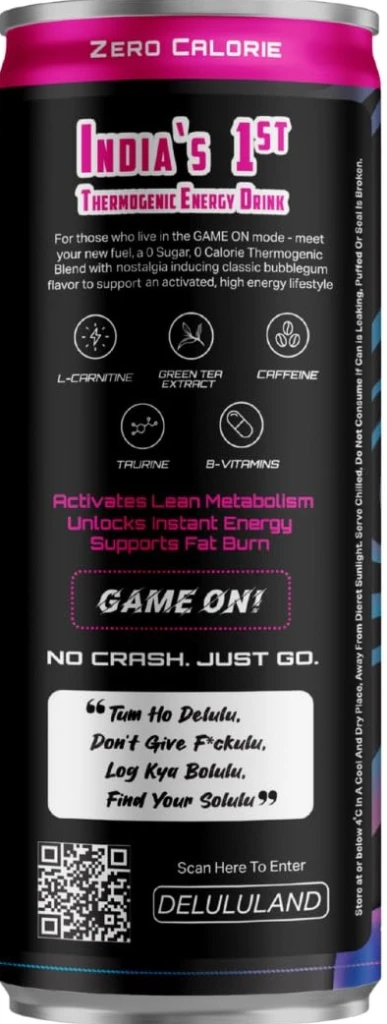
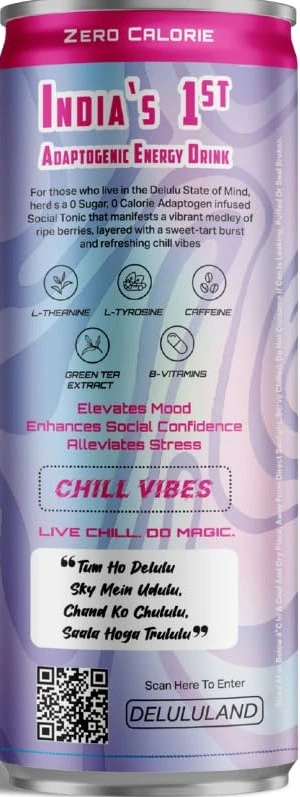
Pack image shown to identify the product. Decode Label is independent of DELULULAND and is not sponsored or endorsed by it. Trademarks
Thermogenic Energy Drink
Decode Label Safety Score
How we got 4.5 ShowHide
Methodology v3.1 (updated 8 Oct 2026) — what changed
This energy drink contains artificial sweeteners, Acesulfame Potassium and Sucralose, which are a primary concern for those monitoring their intake of such additives. Additionally, has the potential to form benzene, a known carcinogen, although the actual formation and levels in beverages are complex and depend on various factors. While the product provides some B vitamins and L-Carnitine, its overall profile is that of an ultra-processed beverage with no significant nutritional benefits beyond the added vitamins. It is generally suitable for healthy adults in moderation, but individuals sensitive to artificial sweeteners or those with specific health conditions should exercise caution.
At a glance
From the declared label — not a lab testFindings to weigh
What’s favorable
- Taurine
- L-Carnitine
- Vitamin C
- Vitamin B6
- Vitamin B12
Contains artificial sweeteners and a preservative that can form benzene
This energy drink includes artificial sweeteners, Acesulfame Potassium and Sucralose, which some consumers prefer to limit. Though actual levels in beverages are typically low and regulated. The product is an ultra-processed beverage with added vitamins but no other significant nutritional value.
Personal check · free
Is this right for you or your family?
Just checking whether the product is safe? The analysis above is yours, no account needed. To know if it is safe for you, your father or your child, add a profile and we check this label against them.
- Allergies. Peanut, milk, gluten, egg and more, checked against the ingredient list.
- Diet. Vegetarian, vegan, Jain, no egg, no dairy.
- Health and goals. Sugar, salt, protein, steady blood sugar, heart-friendly, weight.
- Everyone you buy for. Save a profile for Papa or the kids and switch in one tap.
Concern breakdown
Score out of 10 · higher = fewer concernsHow this product performs on each concern we check for beverage. This is a breakdown of the same evidence behind the score above — not a separate verdict.
Other audiences
AvoidEnergy drinks containing stimulants like Taurine and artificial sweeteners are generally not recommended for children and adolescents due to potential adverse effects on developing bodies and unsettled long-term health impacts.
Why the score is capped
Highly processed (NOVA); contains artificial sweeteners
Rule F-CAP-09
What's good
Contains essential B vitamins (B6, B12) and Vitamin C
Contains L-Carnitine and Taurine
Watch out for
Presence of artificial sweeteners (Acesulfame Potassium, Sucralose)
Potential for benzene formation from Sodium Benzoate and Vitamin C interaction
Ultra-processed beverage with no significant whole-food nutritional contribution
Ingredient Concerns safety database
Sources cited below may be Indian (FSSAI) or international (EU, US, WHO, IARC) — an international classification or law is evidence, not an Indian regulatory finding.
Sodium Benzoate (E211)
Benzoates are permitted preservatives with an established acceptable daily intake. Two documented concerns: in acidic drinks that also contain ascorbic acid (vitamin C) they can slowly form small amounts of benzene, especially with heat and light (US FDA beverage survey, 2006); and sodium benzoate was one of the additives in the Southampton study mixtures associated with hyperactivity in children. It can also trigger reactions in some people with asthma or urticaria.
Regulatory & scientific authority Source: EFSA re-evaluation of benzoic acid and benzoates (2016); US FDA benzene-in-beverages survey (2006); McCann et al., Lancet 2007
Sodium Benzoate: regulation, sources and other products →Sucralose (E955)
Sucralose is an approved intense sweetener with an established acceptable daily intake. The WHO (2023) advises against relying on non-sugar sweeteners for weight control, and research into long-term gut and metabolic effects is ongoing. Heating it at very high temperatures is not recommended.
Regulatory & scientific authority Source: WHO guideline on non-sugar sweeteners (2023); EFSA/JECFA acceptable daily intake
Sucralose: regulation, sources and other products →Acesulfame Potassium (E950)
Acesulfame K is an approved intense sweetener. Regulators set an acceptable daily intake and consider it safe within it, but the WHO (2023) advises against using non-sugar sweeteners to control body weight because there is no long-term benefit and possible long-term harms, and long-term research on gut and metabolic effects is still developing.
Regulatory & scientific authority Source: WHO guideline on non-sugar sweeteners (2023); EFSA/JECFA acceptable daily intake
Acesulfame Potassium: regulation, sources and other products →Decode Label Analysis
Contains two artificial sweeteners, Acesulfame Potassium and Sucralose, whose long-term health effects are still under research and may be a concern for some consumers.
Combined Effects interactions
Sodium Benzoate (INS 211) can react with Vitamin C (Ascorbic Acid) to form benzene, an IARC Group 1 carcinogen. The reaction is influenced by factors like heat, light, and storage conditions. While regulatory limits exist for benzene in beverages, its potential formation is a concern.
Claim check
2 claims not supported by label dataFront-of-pack marketing claims checked against this product's actual ingredients and nutrition. "Can't verify" means the label does not provide enough information to check the claim — it is not the same as the claim being false.
The nutrition information states 4.8 kcal per 100g, which is not zero calories.
The nutrition information states 4.8 kcal per 100g, which is not zero calories.
Market rank + professional endorsement claim — requires independent survey data and clinical evidence to substantiate; cannot be assessed from label data alone.
Caffeine is not explicitly listed as an ingredient, although it could be present in the Green Tea Extract. Without explicit listing, the claim cannot be fully verified.
This is a functional claim that cannot be verified from the provided ingredient list or nutrition facts.
This is a functional claim that cannot be verified from the provided ingredient list or nutrition facts.
This is a functional claim that cannot be verified from the provided ingredient list or nutrition facts.
This is a subjective experience claim that cannot be verified from the provided label information.
The nutrition information states 0g of sugar per 100g.
L-Carnitine is listed in the ingredients.
Green Tea Extract is listed in the ingredients.
Read straight from the back-of-pack photo — quantities, sections and any disguised terms, so the small print can’t hide behind the marketing.
-
1.
Carbonated Water
-
2.
Taurine 400mg/100 mlTaurine (400 mg/100 ml)
-
3.
Acidity RegulatorsMalic acid (INS 296), Citric acid (INS 330)Acidity Regulators (INS 296, INS 330)
-
Malic Acid within Acidity RegulatorsINS 296
-
Citric Acid within Acidity RegulatorsINS 330
-
4.
Acesulfame Potassium
-
5.
Sucralose
-
6.
Class II PreservativesSodium benzoate (INS 211), Potassium sorbate (INS 202)Class II Preservatives (INS 211, INS 202)
-
Sodium Benzoate within Class II PreservativesINS 211
-
Potassium Sorbate within Class II PreservativesINS 202
-
7.
Green Tea Extract trace amount
-
8.
L-Carnitine
-
9.
Vitamin CVit C
-
10.
Common Salt
-
11.
Vitamin B6Vit B6
-
12.
Vitamin B12Vit B12
Trace amounts: some named ingredients appear in token quantities or low in the list. At these concentrations a meaningful benefit is unlikely, and their front-of-pack prominence may not reflect their level in the formulation.
In label order — normally largest quantity first. Select a row for the full write-up and sources.
✓ Decode Label Assessment: Favorable ⚠ Decode Label Assessment: Concern Decode Label Assessment: Neutral
Who should take caution
About this ingredient
Declared on this label as
No detailed safety data in our database yet for this ingredient.
Learn More
| Energy | 4.8 kcal |
| Protein | 0 g |
| Carbohydrate | 1.2 g |
| Total Sugars | 0 g |
| Added Sugars | 0 g |
| Total Fat | 0 g |
| Dietary Fibre | 0 g |
| Sodium | 16 mg |
| Vit C | 5 mg |
| Vit B3 | 0.5 mg |
| Vit B6 | 0.8 mg |
| Vit B12 | 1 mg |
| Cholesterol | 0 g |
Colour shows the per-100g level (green = low, amber = moderate, red = high), from the product's label.
Compare with other energy drink products
Assessed using the same Decode Label methodology, sorted by score. Each score reflects the information available for that product at the time of assessment.
Also on this shelf
More Energy & Sports Drink products we've analysed, in name order.
What are the ingredients in Thermogenic Energy Drink?
The label of Thermogenic Energy Drink lists 16 ingredients, in label order: Carbonated Water, Taurine, Acidity Regulator, Malic Acid, Citric Acid, Acesulfame Potassium, Sucralose, Class II Preservative, Sodium Benzoate, Potassium Sorbate, Green Tea Extract, L-Carnitine, Vitamin C, Common Salt, Vitamin B6, Vitamin B12. Flagged by the analysis: Acesulfame Potassium, Sucralose.
Is Thermogenic Energy Drink safe to eat?
Thermogenic Energy Drink scores 4.5/10 on Decode Label (Moderate). This energy drink includes artificial sweeteners, Acesulfame Potassium and Sucralose, which some consumers prefer to limit. Though actual levels in beverages are typically low and regulated. The product is an ultra-processed beverage with added vitamins but no other significant nutritional value.
Why does Thermogenic Energy Drink score 4.5/10?
Flagged in the score: Presence of artificial sweeteners (Acesulfame Potassium, Sucralose). Also noted: Potential for benzene formation from Sodium Benzoate and Vitamin C interaction. Ultra-processed beverage with no significant whole-food nutritional contribution.
Who should avoid Thermogenic Energy Drink?
The points the analysis notes are most relevant to: Avoiding artificial sweeteners (Acesulfame Potassium, Sucralose); Sensitive to preservatives (Sodium Benzoate, Potassium Sorbate); Avoiding IARC Group 1 carcinogens (potential benzene formation).
How much sugar is in Thermogenic Energy Drink?
0 g of total sugar per 100 ml. The label declares 0 g of that as added sugar per 100 ml.
Does Thermogenic Energy Drink contain caffeine?
Yes — the ingredient list names Green Tea Extract, a source of caffeine. Check the pack for the amount per serving, especially when buying for children or during pregnancy.
Are the claims on the Thermogenic Energy Drink pack accurate?
Decode Label checked 11 claims against the ingredient list and nutrition panel. "ZERO CALORIE" — false. "0 Calorie" — false. "India's 1st Thermogenic Energy Drink" — can't be verified from the label.
Is Thermogenic Energy Drink vegetarian?
Thermogenic Energy Drink is marked vegetarian.
Answers are generated from this product's own Decode Label analysis — the score, the ingredient list and the label claims shown above. Always check the pack itself for allergen and dietary information.
Reader reviews
How the product performed for people who used it — taste, value, everyday experience. Separate from the Decode Label score above, which rates what is on the label.
Sign in to leave a review.
Sign in →No reviews yet — be the first to share your experience.
Help us keep this accurate
Two quick questions about our analysis — not about the product.
Was this analysis helpful?
Tells us whether the breakdown above actually answered your question.
0 of 0 readers found this analysis helpful
Does your pack match this page?
Recipes change and packs get reformulated. If the ingredients or the panel on the pack in your hand differ from what we show, tell us and we will check it.
About this analysis: Based on declared label information and available evidence. Decode Label does not independently laboratory-test products, and a score is not a regulatory determination or medical advice.
Disclaimer: Safety scores are Decode Label-generated assessments based on publicly available regulatory data (FSSAI, WHO, EFSA, IARC) and peer-reviewed research. They are not a substitute for professional medical advice, and they are not a regulatory determination, a laboratory safety certification or a medical diagnosis. Ingredient safety can vary by individual health conditions, concentration, and usage context. Decode Label is an independent information service and scores every brand by the same rules. No brand pays for or influences its score. Our founder also founded the personal-care brand Botani Bestie (see our story); its products are scored exactly like everyone else's. Data limitations: This assessment is based on the information declared on the product label and the evidence sources above — Decode Label does not independently laboratory-test this product. Ingredient concentrations, sourcing and manufacturing can vary between batches and are not always disclosed. A finding that is not shown here means it was not identified from the available label information, not that it has been ruled out.
Report Error
If you believe this score is inaccurate, provide details below. Our team reviews every report and will update the rating if warranted.
Report submitted
Our team will review your report and update the rating if the evidence warrants it. Thank you for helping keep our data accurate.
Share this product
Thermogenic Energy Drink
Link copied — paste it in your Instagram bio or Story!